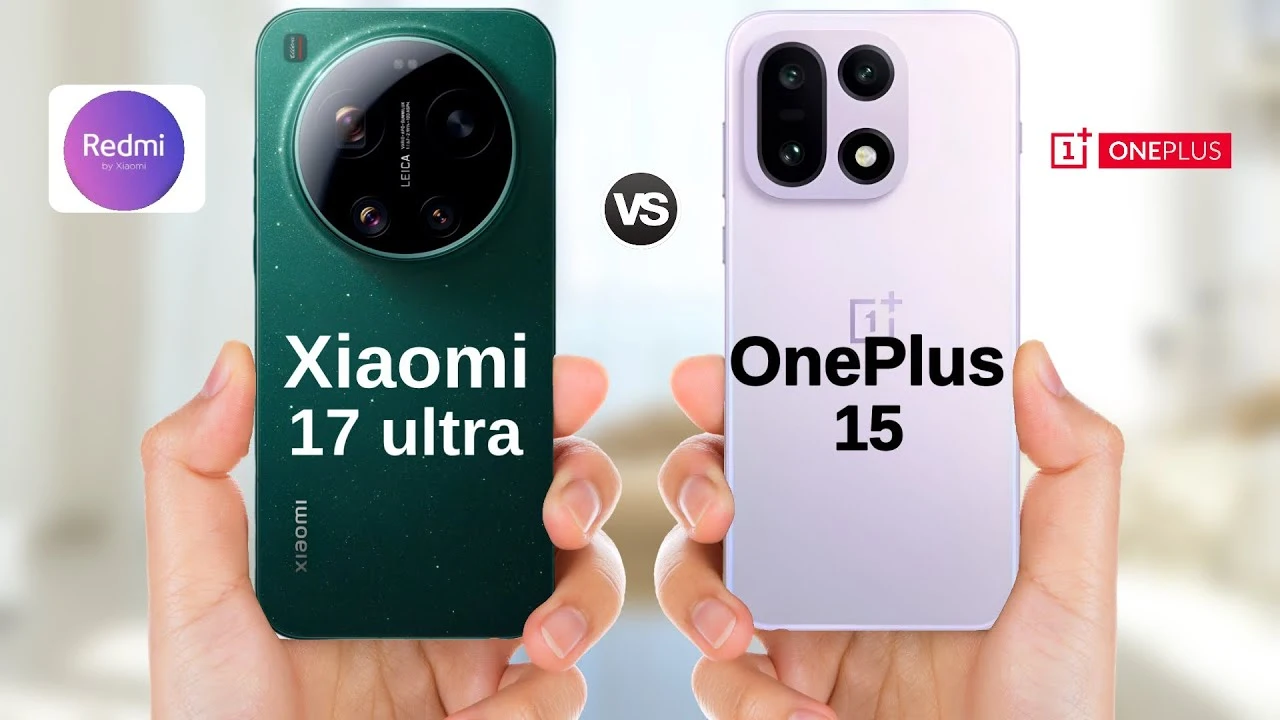
Summary table — key differences at a glance
| Feature / Aspect | Xiaomi 17 Ultra | OnePlus 15 |
|---|---|---|
| Display | 6.9″ LTPO AMOLED, 120 Hz, 1440×3200 (≈1.5K), high brightness, Dolby Vision, large 6.9″ panel | 6.78″ LTPO AMOLED, 165 Hz refresh rate for smoother UI/gaming, 1272×2772 resolution, high peak brightness (approx. 1800 nits HBM / higher brightness in tests) |
| Build & Design | Larger body: ~162.9 mm × 77.6 mm × 8.29 mm, ~230–224 g weight — big, camera-centric, slightly heavier build, emphasizes professional-style camera hardware and photography tools | Slightly more compact: ~161.4 mm × 76.7 mm × 8.1 mm, ~211 g weight — more manageable in hand, sleek flagship feel ( |
| Chipset & Performance | Snapdragon 8 Elite Gen 5 (flagship-tier, same as OnePlus 15), high-end performance for heavy apps / photography workflows / multitasking | Snapdragon 8 Elite Gen 5 as well — with tuning optimized for fluid UI, gaming, high refresh rate, and peak responsiveness |
| Cameras | Triple rear with strong zoom emphasis: versatile for wide, zoom, ultrawide + periscope / telephoto camera setup tuned for higher zoom, detail and pro-style photography | Balanced triple-camera setup (wide + ultrawide + telephoto) — good for everyday shooting, more balanced and consistent across scenarios, but relative “all-rounder” rather than ultra-zoom specialist |
| Battery & Charging | Large battery (specs suggest strong endurance), decent charging & often strong battery life suitable for content creation, photography, heavy use | Very large battery (~7300 mAh), plus fast charging and good optimization — excellent for heavy daily use, gaming, long sessions away from charger |
| Ideal usage scenario | Photography, content creation, zoom-heavy photo/video work, heavy multitasking, long media/photo/video editing sessions | Gaming, fluid UI, everyday heavy usage, long battery + fast charging + responsive performance |
Design comparison
Xiaomi 17 Ultra leans into a “creator / pro-photographer” style: a larger body to accommodate a powerful camera system, bigger display and perhaps better thermal / battery capacity. The build feels heavier, but this is the trade-off for enhanced camera hardware and a large canvas.
OnePlus 15 aims for a more balanced flagship design — a slightly more compact and lighter body, easier to handle day-to-day, pocket-friendly yet still premium-feel. For users wanting a flagship that’s easy to carry and use one-handed, OnePlus 15 feels more practical.
Verdict on design: Choose Xiaomi 17 Ultra if you prioritize camera capabilities and don’t mind a larger phone; choose OnePlus 15 if you value portability and everyday comfort.
Display comparison
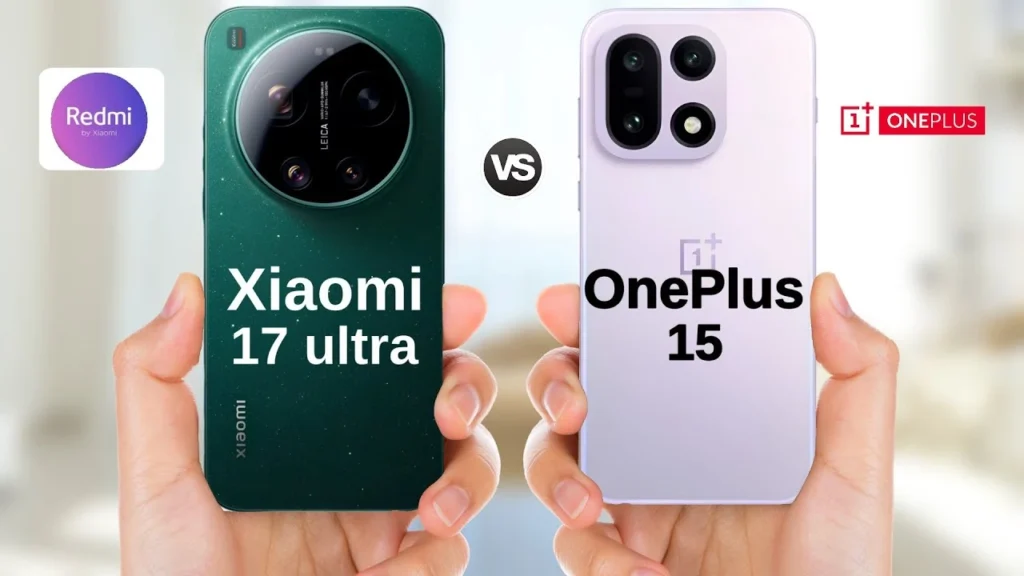
Xiaomi 17 Ultra offers a large 6.9″ LTPO AMOLED panel with Dolby Vision support and high resolution — excellent for media consumption, editing photos/videos, and immersive content. The large screen benefits creators or media enthusiasts.
OnePlus 15 uses a slightly smaller 6.78″ LTPO AMOLED with a 165 Hz refresh rate, which means smoother animations, faster responsiveness, and a more fluid experience — particularly advantageous for gaming, scrolling, and immediate responsiveness. Its brightness and HDR capabilities make it well-balanced for everyday use too.
Verdict on display: For creative work, media, and content consumption — Xiaomi 17 Ultra’s large, high-resolution panel has the edge. For speed, UI smoothness and gaming — OnePlus 15’s high refresh rate display stands out.
Camera comparison
Xiaomi 17 Ultra’s rear camera system is geared toward versatility and high-zoom photography — ideal for enthusiasts, creators and those who care about strong zoom, varied shots (wide, telephoto, ultrawide) and flexibility. The phone’s design and tuning aim for pro-style photos.
OnePlus 15 delivers a balanced, reliable camera setup: a main lens, ultrawide, telephoto — great for everyday photos, decent portraits and consistent results across lighting. It may not offer as aggressive a zoom or pro-level flexibility, but it promises steadiness and suitability for general users.
Verdict on cameras: For photography-centric users or those who want maximum flexibility (zoom, varied shots) — Xiaomi 17 Ultra wins. For reliable, balanced everyday photography — OnePlus 15 is simpler and sufficient.
Performance comparison
Both phones are powered by the same flagship chipset (Snapdragon 8 Elite Gen 5) with high-end RAM and storage configurations — meaning they are equally capable of handling heavy apps, gaming, multitasking, and demanding workloads.
OnePlus 15, however, is tuned more aggressively for high refresh rate display, faster animations, and gaming — delivering perhaps a slightly more “snappy” user experience under interactive workloads.
Xiaomi 17 Ultra, with its larger body and design, may provide better stability under long sessions (editing, heavy multitasking, camera use) — aiming for sustained performance rather than peak responsiveness.
Verdict on performance: For raw power and flexibility they tie. For gaming and fast UI, OnePlus 15 has a slight edge. For long creative / editing sessions or balanced performance with camera-heavy workloads, Xiaomi 17 Ultra may feel more stable.
Battery & charging
OnePlus 15 houses a very large battery (~7300 mAh) and offers extremely fast wired charging (reports up to 120 W in some regions) plus wireless charging — meaning excellent endurance and quick top-ups for heavy users, gamers, travelers.
Xiaomi 17 Ultra also offers generous battery capacity (though slightly lower than OP15 in some spec listings) and balanced charging — sufficient for all-day heavy use, media editing, camera work, without frequent charging.
Verdict on battery: OnePlus 15 likely gives longer battery life plus faster charging — more suited to users who use phones intensively and need quick refuels. Xiaomi 17 Ultra still offers solid endurance but leans toward balanced battery + camera / performance trade-off.
Final thoughts: which should you pick?
Choose Xiaomi 17 Ultra if you are:
- A creator, photographer or content-maker needing a powerful zoom camera and flexible shooting options.
- Using the phone for media consumption, editing, long video/photo sessions — a large display and stable performance matter.
- Preferring versatility and balanced flagship capabilities (camera + display + performance + battery) rather than raw speed alone.
Choose OnePlus 15 if you are:
- A gamer, heavy user, or someone valuing smooth UI, quick responsiveness, and high refresh rate for gaming / multitasking.
- Always on the go and care about long battery life + fast charging — frequent travel, heavy daily usage without waiting for charging.
- Preferring a slightly lighter, more compact phone with flagship-level performance and balance.
In short: Xiaomi 17 Ultra = powerful, creative-focused, all-rounder flagship. OnePlus 15 = performance-first, battery-optimized, fast and fluid flagship.
3 Frequently Asked Questions
1) Is there a big difference in display smoothness between Xiaomi 17 Ultra and OnePlus 15?
Yes — OnePlus 15’s 165 Hz refresh rate gives noticeably smoother animations, scrolling, and gaming compared to Xiaomi 17 Ultra’s 120 Hz. If you value fluidity over ultra-high resolution, OnePlus 15 feels quicker.
2) Which phone has better battery life?
OnePlus 15 has a slight advantage because of a larger battery and very fast charging support, making it more suitable for heavy users, gamers, or people who are away from chargers often.
3) If I care about camera versatility (zoom, wide-angle, pro shots), which phone should I choose?
Xiaomi 17 Ultra — its camera setup and tuning are more oriented toward versatility, zoom capability, and flexibility for creative photography, making it the better choice for photography-heavy users.